
Every once in a while, a single release hijacks the watch world’s attention for an entire calendar year. In 2026, that watch didn’t come from Rolex, Omega, or Tudor. It actually came from Longines.
Since its debut this past March, the redesigned HydroConquest has been hailed by many as the release of the year, and quite possibly the most hyped watch of 2026. Enthusiast forums lit up overnight, dealers have struggled to keep cases stocked, and if owner reports are to be believed, some variants have carried waitlists stretching a full three months.
Then again, if you’ve been following along with us, it shouldn’t come as a surprise. Between the Spirit Pilot, the Spirit Zulu Time Titanium, the Legend Diver, and the Conquest 38mm (all of which we’ve reviewed, so be sure to check those out), Longines has been on an absolute tear.
The brand keeps listening to enthusiast feedback, keeps delivering near-luxury quality, and somehow keeps prices in check while its competitors continue to sprint upmarket. We’ve covered Longines’ Saint-Imier origins in depth before, so today we’re zeroing in on the collection at hand.
The HydroConquest arrived in 2007 as the dive-ready offshoot of 1954’s Conquest line, defined by its oversized 6, 9, and 12 numerals. Ceramic bezels followed in 2018, but it was 2023’s HydroConquest GMT that previewed the cleaner design language you see here.
And now the three-hander has finally caught up, and the result is the watch everyone’s been talking about.
So without further ado, let’s take a closer look at the Longines HydroConquest.
At A Glance
Case Size: 42mm
Lug to Lug: 51.2mm
Case Thickness: 11.7mm
Case Material: Stainless steel
Water Resistance: 300m (30 bar)
Movement Type: Automatic
Power Reserve: 72 hours
Movement: Longines L888.5
Lume: Two-tone Swiss Super-LumiNova
Crystal: Sapphire, AR-coated on both sides
Band: Stainless steel H-link bracelet
Price: $2,200
First Impressions
Alright, let’s start with why the 42mm version is on our wrist instead of the more buzzed about 39mm. After a run of smaller divers, we deliberately wanted something larger this time around, so we sized up.
And our first impression out of the box? Even for a crew actively shopping for a bigger dive watch, this thing runs big.
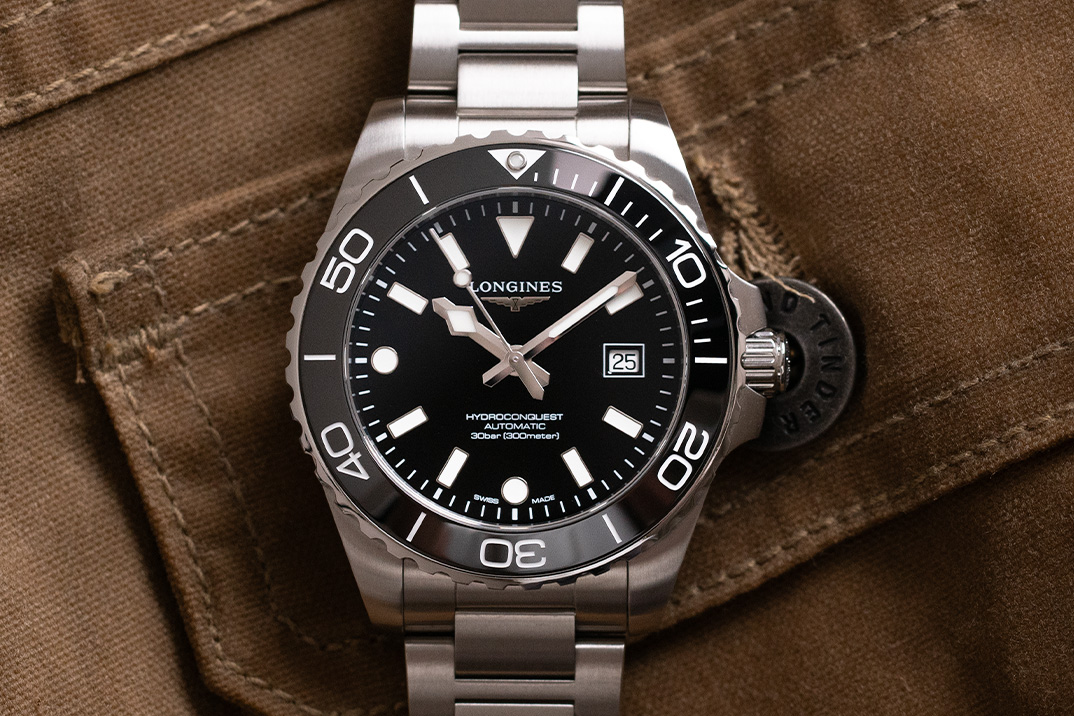
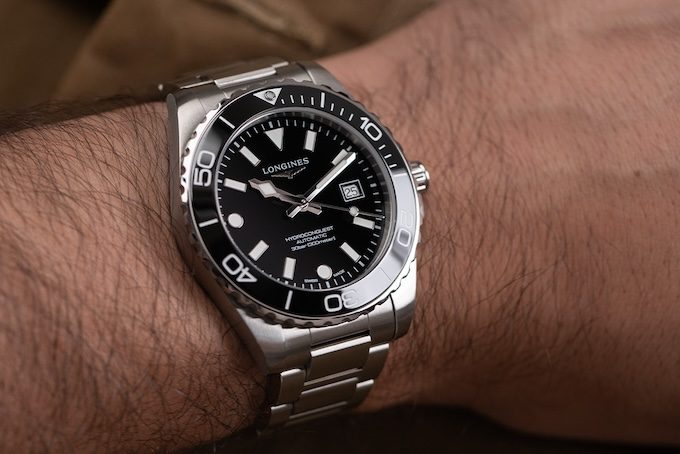
On paper, 42mm sounds pretty manageable. In person, however, the broad, toothy bezel hangs out past the case, the dial leaves plenty of negative space, and the whole package wears with a bit more presence than the numbers suggest.
On our producer’s 6.75″ wrist, it comes across closer to a 43 or 44mm diver, and plenty of hands-on reviewers have echoed that both sizes wear large for their stated dimensions. It’s a bit of a chunky tool watch. That’s not a knock, per se, but it’s something you should absolutely try on before purchasing.
The other elephant in the room is the design itself. With the signature Arabic numerals gone, the community has immediately (and unsurprisingly) split into two camps: those who see a cleaner, more mature diver, and those who see a watch that traded its personality for a Submariner-shaped silhouette. We’ll weigh in on that debate when we get to the dial.
What’s not up for debate is the quality on display here for Longines. The lacquered dial, the glossy ceramic, and the all-brushed case read far more expensive than the price tag implies, and the 11.7mm thickness keeps everything surprisingly wearable.
The Case
Measuring in at 42mm wide, with a 51.2mm lug-to-lug and an 11.7mm thickness, the stainless steel case is simultaneously this watch’s greatest strength and its biggest weakness.
That 11.7mm figure makes the HydroConquest thinner than a Tudor Black Bay 58 and a full 1.9mm thinner than Omega’s Seamaster Diver 300M, so it slides under a cuff like few 300m divers can. But that 51.2mm lug-to-lug is serious real estate, and the lugs don’t curve downward dramatically, so smaller wrists should proceed with caution. At 180g on the full bracelet, it’s got some honest heft to it, too. But, seeing that it’s a dive watch, we’re not necessarily mad about any of it.
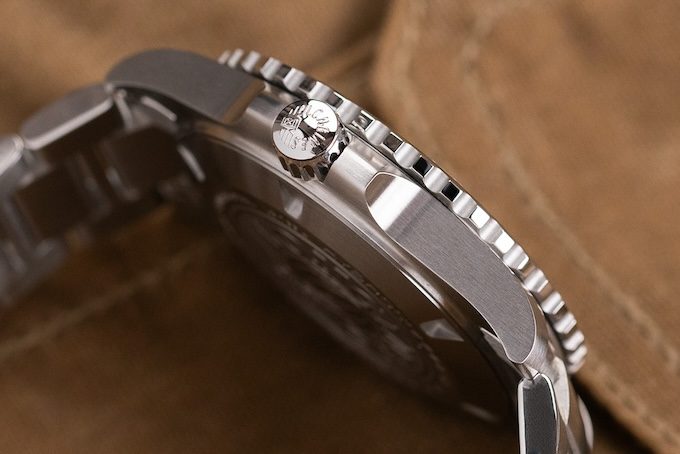
The finishing is a handsome, utilitarian affair, fully brushed from end to end, which suits the tool-first brief and hides scratches well. Up top, the 120-click unidirectional bezel borrows its mechanism from the excellent Ultra-Chron diver.
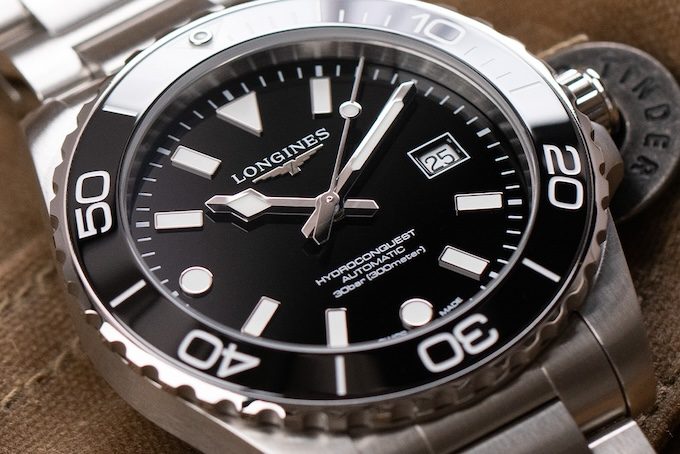
The action is tight and controlled with minimal back play, and the aggressive knurling now runs the entire circumference, correcting the old model’s partially smooth (and frankly kind of baffling) grip sections. The glossy black ceramic insert features inset markings and a lumed pip at 12, and it feels premium every time you interact with it.
Longines also reworked the crown guards, which are slimmer and more tapered than the chiseled units of old, leaving easy access to the logo-embossed screw-down crown.
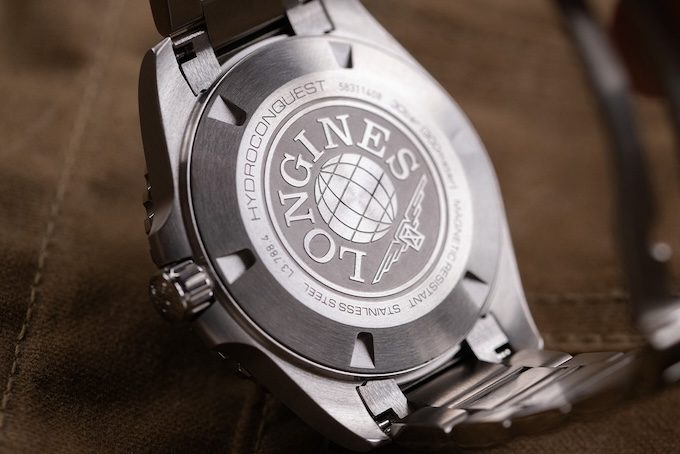
The watch is rated to a legitimate 300m of water resistance, and the solid screw-down caseback wears an engraved globe motif with the winged hourglass logo, along with “MAGNETIC RESISTANT” text that hints at what’s ticking inside.
The Dial
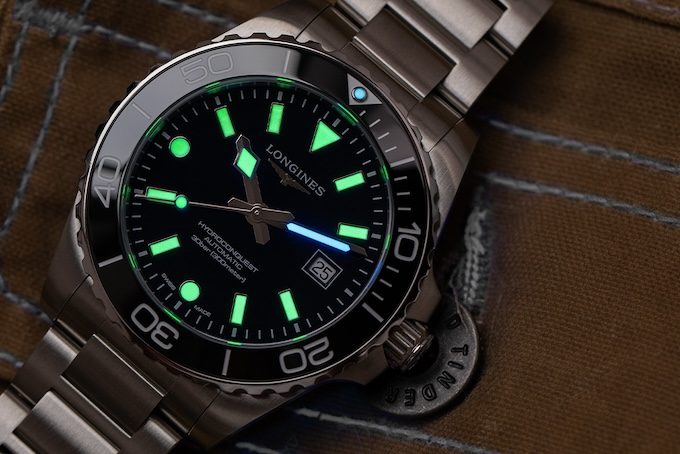
The black lacquered dial is where this generation makes its biggest break from the past, and in our eyes, it’s mostly for the better. The glossy, polished finish replaces the sunray dials of earlier models and gives the watch a richer, more upscale look, while the printed “HYDROCONQUEST AUTOMATIC 30bar (300meter)” text balances the applied Longines wordmark and winged hourglass up top.
The old oversized numerals have given way to applied, rhodium-plated geometric indices: an inverted triangle at 12, circles at 6 and 9, and rectangles everywhere else. This is the layout everyone has an opinion about. Some say the two circles look out of place against the rectangular, white-framed date window at 3, and we definitely understand the symmetry argument here.
From our end, though, it’s a minor design preference rather than a design flaw, and the circles are a subtle nod to dive watch convention flipped on its head (it’s essentially a Submariner layout in reverse). So perhaps what the watch loses in quirk, it’s actually gaining in versatility.art
The handset carries over the collection’s best bit of personality as well which includes a sword-style minute hand, a lollipop seconds hand, and an hour hand with a diamond-shaped tip that feels a bit like a stretched-out take on Tudor’s snowflake.
All three are mirror-polished, which does stand out against the otherwise all-brushed watch. We would’ve loved to see some brushing worked into the hands to tie the whole package together.
As for the lume, Longines applies two tones of Swiss Super-LumiNova. In person, the indices and hour hand glow green while the minute hand glows a distinct blue, a nice trick we always appreciate for telling the hands apart at a glance in the dark.
The application is generous, and it’s noticeably thicker than the outgoing generation’s. And, during our time with the watch so far it’s been perfectly fine. We don’t have any complaints on nighttime legibility, even if it hasn’t exactly blown us away.
It does seem to be a clear step up from previous HydroConquests, but you’re still not getting that Seiko or Citizen glow we love so much on the cheaper dive watches.
And for the spec sticklers, the date window means there’s no lume plot at 3 o’clock, which is a small omission worth noting.
A flat sapphire crystal with multiple layers of anti-reflective coating on both sides keeps everything legible at an angle, though we’d have welcomed a slight dome for just a touch more character.
The Movement
Inside beats the caliber L888.5, a Longines-exclusive automatic built on an ETA 2892-A2-derived base and assembled for the brand within the Swatch Group.
By slowing the beat rate to a slightly unusual 25,200 vph (3.5Hz), Longines extracts a full 72 hours of power reserve.
The headline upgrade for this generation is the monocrystalline silicon balance spring, which brings magnetic resistance that clears the ISO 764 standard with some room to spare. Combined with the 300m rating, that makes this a true grab-and-go tool you can toss in a backpack next to a laptop without a second thought. You also get hacking seconds, hand-winding, and 21 jewels.
What you don’t get is COSC certification, which Longines reserves for the likes of the Spirit collection and the Legend Diver. That’s a fair cost-cutting measure at this price, and owner-reported accuracy has been consistently strong, but another spec we thought was worth noting.
The Bracelet
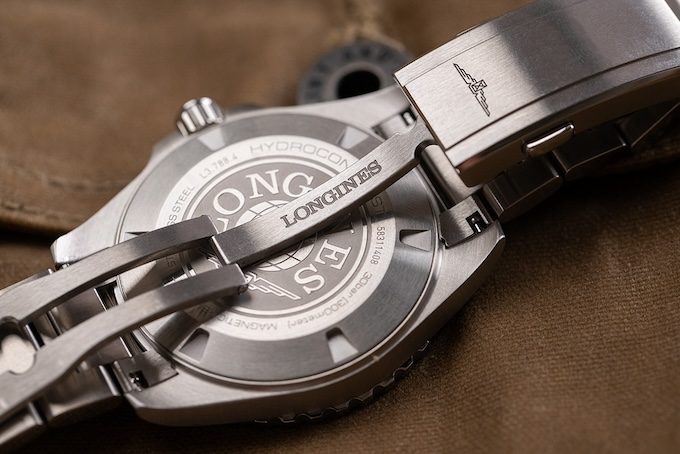
The 21mm H-link bracelet is easily one of the biggest (and our personal favorite) upgrades of this generation. The polished center links of the outgoing model are gone, replaced by a fully brushed finish that matches the case and sheds the old scratch-magnet problem.
The links taper pretty meaningfully toward the clasp, which also helps balance out the watch’s substantial head.
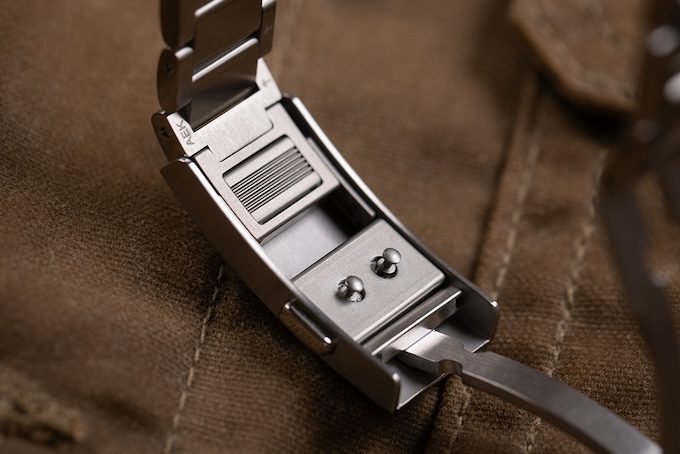
The milled double push-button safety clasp is excellent, anchored by a tool-free micro-adjust that slides across four positions of roughly 5mm of total range.
It’s the single feature owners have raved about most, and we get it, though we’d have welcomed another position or two for dialed-in fits on hotter days.
Our few critiques here are the familiar ones: the links are joined by pins rather than screws, there’s no quick-release system, and the 21mm lug width makes aftermarket strap hunting harder than it should be.
Conclusion
So, the age old question we end every review with – is the 2026 Longines Hydroconquest worth it?
At $2,200, the value math is almost unfair. A Tudor Black Bay 58 now starts at around $5,000, Omega’s Seamaster Diver 300M sits at well over $6,000, and even Longines’ own Legend Diver 39mm (another one of our personal favorites) commands $3,850.
So, if you want a 300m ceramic-bezel diver from a heritage Swiss brand, nothing touches this package at this price. Dip below it, and something like Mido’s Ocean Star 200C at around $1,300 gets you a ceramic bezel and an 80-hour reserve for a lot less, though you drop to 200m of water resistance and a step down in finishing.
Now, to be clear, this watch is NOT a Black Bay or Seamaster killer, and if one of those is your grail, by all means you should buy the grail. This is the watch for the enthusiast stepping into their first serious Swiss diver, or the seasoned collector who wants a do-anything daily they won’t baby. Our only firm advice is to try both sizes in person. Having spent time with the 39mm, that’s the one we’d personally go with, and even it runs a touch large.
The hype machine gets it wrong all the time. But this time, it found a watch that actually delivered, and we applaud Longines for continuing to do so.
Recap
Longines HydroConquest 42mm
The most hyped dive watch of 2026 backs it up, packing a 300m rating, a ceramic bezel, and a 72-hour silicon-sprung automatic into a slim case for just $2,200. Just know it wears noticeably larger than its dimensions suggest.

Pros
- Unbeatable value at $2,200
- Slim 11.7mm case with 300m water resistance
- Crisp 120-click ceramic bezel
- 72-hour power reserve with silicon balance spring
- Fully brushed bracelet with tool-free micro-adjust
- Two-tone green and blue lume
Cons
- Wears larger than its dimensions suggest
- No quick-release or screwed links
- 21mm lug width limits strap options
- Lume trails Seiko and Citizen rivals
- No COSC certification