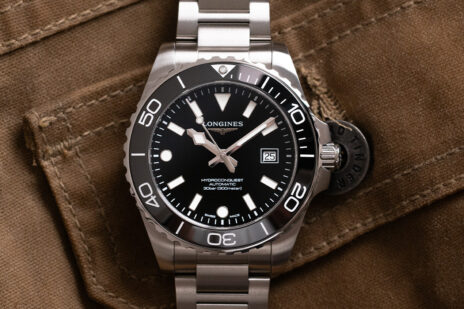
Luxury dive watches occupy a unique space in horology. They’re the watches with legitimate tool-watch DNA, born from a genre that was originally purpose-built for commercial and military diving, but executed with the kind of finishing, materials, and movement craftsmanship that earns the luxury designation. From Blancpain pioneering the modern dive watch in 1953 to Omega putting one on Bond’s wrist, this is a category with real heritage and real horological significance.
For us, we defined “luxury” starting at the $3,000 mark, and that’s where we’re kicking off this guide. But beyond that price point, we wanted to focus specifically on luxury dive watches built for everyday wear. We’re not interested in 1,000-meter saturation divers built for commercial work (we’re not commercial divers, after all). We’re talking about watches you can throw on with a t-shirt, slide under a cuff at the office, take to dinner, and yes, still take in the water if you want to.

Where’s The Rolex Submariner?
Now, we have to address the elephant in the room. We intentionally left the Rolex Submariner off this guide. We love the Sub – it’s the king of this category, without question.
It’s the watch that every other dive watch on this list, in some way, is measured against. But everyone knows the Submariner. Including it would just feel like lip service to a watch that doesn’t need any more attention from us.
Video Review: 10 Best Luxury Dive Watches
While we love reading, nothing beats a high production video – especially for luxury diver. Be sure to check to check our video guide to the best luxury dive watches, in all its 4K glory.
Note: For reference, all watches are shown on our wearer’s 6.75″ wrist.
Doxa Sub 300 Searambler

Pros
- Unmistakable wrist presence, nothing else looks like it
- Authentic heritage with Cousteau cosign
- Silver/orange colorway is the most versatile of the trio
- Beads of rice bracelet is iconic
Cons
- Takes time to adjust to the smaller dial aperture
- Clasp doesn’t match the case and bracelet quality
We’re kicking things off with a watch that has more diving credibility than just about anything else on this guide. The Doxa Sub 300 Searambler is far from a desk diver, but that doesn’t mean you can’t rock one on the daily.
Doxa’s been at it since 1889, and in 1967 they introduced the original Sub 300 at Basel. At the time, it was billed as the first purpose-built dive watch that was truly accessible to the public. It brought the patented unidirectional bezel with its dual scale for dive time and depth, and Jacques Cousteau famously wore one.

The C-shaped cushion case is hard not to love. It comes in at 42.5mm across, 45mm lug-to-lug, and 13.4mm thick. Nothing else on this guide wears quite like it. The dial aperture reads smaller than the case suggests because of how much space the dual bezel and chapter ring take up, and that does take some to adjust to.
The Searambler is the silver-dial variant of the original 1967 trio, and that silver sunburst dial with the orange minute hand provides just the right amount of versatility for daily wear. Hour markers and hands are filled with Super-LumiNova, the framed date sits at 3, and the boxed sapphire mimics the domed plexi of the ’67 original almost exactly.

Inside is a Swiss automatic, COSC-certified, beating at 28,800 vph with a 38-hour power reserve. Doxa doesn’t publicly name the base caliber, though historically these have run on ETA platforms.
We’re suckers for a good beads of rice bracelet. Seven links, brushed outers and polished inners, tapering 22mm to 20mm at a folding clasp, and finished off with a wetsuit extension. The clasp definitely isn’t the most refined here, but the bracelet is also a huge part of the charm.
Read our full review of the Doxa Sub 300 here.
Case Size: 42.5mm
Case Material: Stainless steel
Movement: Swiss automatic, COSC-certified (28,800 vph, 38-hour PR)
Water Resistance: 300m
Longines Legend Diver

Pros
- Genuine super-compressor heritage
- White dial is striking and versatile
- Tool-free micro-adjust clasp is a real win for daily wear
Cons
- Pin-and-collar bracelet feels like a corner cut at this price
- Lume falls short of competitors
- Internal bezel less convenient than external
- Significant price climb in recent years
Few watches across any genre have earned a permanent spot in our rotation quite like the Longines Legend Diver, and it’s the mid-century design language that keeps us coming back. And for the price point, you’d be hard-pressed to find better value in Swiss watchmaking right now than Longines – they’re killing it across the board.
Founded in 1832 in Saint-Imier, Longines released the original reference 7042 in 1959, an EPSA-built super-compressor diver that used water pressure to actually improve the case seal. The dual-crown layout protected the internal rotating bezel from accidental adjustment underwater. It’s a piece of real horological history, and notably, Longines beat Tudor’s Black Bay heritage diver revival by a full five years when they brought the Legend Diver back in 2007.

This new white dial variant landed last summer, and it might be the best version yet. The matte finish keeps it from looking too sterile, and the black-on-white contrast is excellent for legibility.
Proportions are damn near perfect at 39mm across, 47mm lug-to-lug, and 12.7mm thick, with 300m of WR and full ISO 6425 certification packed into that slim profile. The dual crowns are the defining feature here, the bezel crown at 2 and the time-setting crown at 4, both cross-hatched and screw-down. The internal bezel turns smoothly without the satisfying clicks of a traditional external unit, but there’s just something really charming about the these internal bezels – and they’re satisfying in their own way.

Inside is the L888.6, a Swatch Group-exclusive caliber assembled at Longines’ Saint-Imier headquarters. It’s COSC-certified, runs a silicon balance spring with magnetic resistance ten times the ISO 764 standard, and delivers a 72-hour power reserve.
The beads-of-rice bracelet uses pin-and-collar links rather than screws, which has drawn fire at this price, and we get it. But the tool-free four-position micro-adjust clasp feels like a small win and makes daily wear significantly better.
Read our full review of the Longines Legend Diver here.
Case Size: 39mm
Case Material: Stainless steel
Movement: Longines L888.6 automatic, COSC-certified (25,200 vph, 72-hour PR)
Water Resistance: 300m
Oris Aquis Date Calibre 400

Pros
- In-house movement competes with the big boys
- Best-in-class 10-year warranty and service interval
- Quick-adjust clasp sizes on the fly
- Independent Swiss brand still doing its own thing
Cons
- Integrated design locks you into proprietary straps
Of every brand on this guide, Oris might be the one we’d hand a fellow enthusiast first, and the Aquis Calibre 400 is a big reason why. The Holstein-based independent has been operating without corporate ownership since 1904, and the Calibre 400 movement program is arguably the boldest move they’ve made in modern memory.
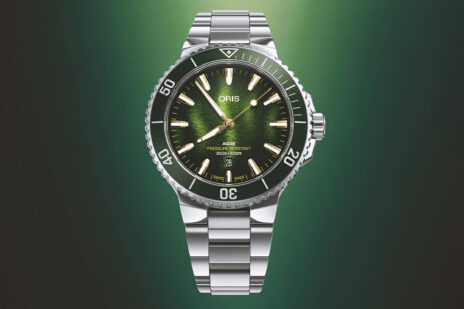
The Aquis itself has been Oris’ flagship diver since 2011, but the version that matters now is the one running their in-house Calibre 400. And this green sunburst dial reference is probably our favorite of the bunch.

The bezel insert and dial are matched in tone, with the dial reading slightly lighter at the center and deepening toward the chapter ring as the box-edge sapphire casts a subtle shadow across the periphery. It’s a great optical effect that gives the dial real depth in person.
The case is 43.5mm across, 50mm lug-to-lug, and 13.5mm thick, with 300m of WR. Those numbers definitely read big on paper, but the steeply sloped lugs make it wear closer to a 41-42mm watch. The unidirectional ceramic bezel turns with a crisp 120-click action, and the screw-down crown sits between substantial guards.
As we mentioned, the Calibre 400 is the headline. Five-day power reserve from twin mainspring barrels, silicon escapement components delivering anti-magnetic resistance up to 2,250 gauss, a chronometer-grade accuracy spec of -3/+5 seconds per day, and Oris’ 10-year recommended service interval with a 10-year warranty when registered through MyOris.

It’s a workhorse caliber dressed up just enough through the exhibition caseback, and when the rotor lines up just right, the twin barrels read as the ears on Oris’ bear mascot, a nice touch of brand personality.
The bracelet uses polished outer links framing brushed centers, screwed throughout, and terminates in Oris’ patented quick-adjust clasp with three on-the-fly micro-adjustment positions, which requires no tools. The integrated design means strap swaps require sticking with Oris’ proprietary options, but those use a quick-release system and the clasp also carries over.
Case Size: 43.5mm
Case Material: Stainless steel
Movement: Oris Calibre 400 automatic (28,800 vph, 120-hour PR)
Water Resistance: 300m
TAG Heuer Aquaracer Professional 300 Date

Pros
- 12-sided bezel gives it real identity
- Wave-textured dial is gorgeous in person
- Often undervalued in the enthusiast conversation
Cons
- Cyclops over the date is polarizing
- Brand baggage from quartz-era reputation
Among watch enthusiasts, the Aquaracer doesn’t always get the respect it deserves. It’s often dismissed as the entry-luxury Swiss diver people buy when they want a recognizable name, while the hardcore community looks elsewhere. The 2024 update is the version that should change minds, and it lands on this guide for good reason.
TAG Heuer’s roots go back to 1860 in Saint-Imier, with the Aquaracer line itself dating to 2005, evolving from the Heuer 2000 series. The 2024 refresh trimmed the case from 43mm to 42mm, slimmed it to 12mm thick, and most importantly, swapped in TAG’s new in-house-developed Calibre TH31-00.

In hand, the proportions are excellent. 42mm across, 48mm lug-to-lug, and 12mm thick make this one of the slimmer divers on this guide. The case finishing leans heavily on brushing with sharp polished chamfers. The 12-sided bezel is the signature detail. It traces back to the line’s 1995 styling, and it’s what keeps this watch from ever being mistaken for a Submariner or Seamaster homage.
The wave-textured black dial is really cool in person, with light play that shifts depending on the angle. The octagonal applied indices at non-cardinal positions and trapezoid markers at 3/9/12 echo the bezel geometry. The integrated cyclops sits underneath the flat sapphire rather than on top, and the light blue chronometer text and seconds hand add just enough color without going overboard.

The Calibre TH31-00 is the headline feature here. Built by Sellita’s higher-end AMT division, COSC-certified, with an 80-hour power reserve, 28,800 vph beat rate, and bidirectional winding that keeps things quiet on the wrist. It’s a meaningful step up from the basic Sellita-based Calibre 5 in older Aquaracers and lines up well with what Tudor and Oris are doing at similar price points.
The brushed three-link bracelet uses a milled clasp with TAG’s slide-style fine adjustment system, which also requires no tools. It’s straightforward, looks good, and works well in practice.
Case Size: 42mm
Case Material: Stainless steel
Movement: TAG Heuer Calibre TH31-00 automatic, COSC-certified (28,800 vph, 80-hour PR)
Water Resistance: 300m
MING 37.09 Bluefin

Pros
- GPHG 2024 Sports Watch Prize winner
- The most unique dial on this guide
- 600m WR without thickening the case
Cons
- Modified Sellita feels light at this price
- Hard to actually buy one
- Lower brand recognition than peers
Ok, we’re halfway through the guide, and we’re to shift gears with something a bit different. The MING 37.09 Bluefin is definitely the wildcard here, and it’s the one watch on this list that probably needs the most introduction. Founded in Kuala Lumpur in 2017 by Ming Thein and a small group of collectors-turned-watchmakers, MING has built one of the strongest design languages in modern horology in under a decade. Production is in Switzerland, output is intentionally limited, and demand consistently outstrips supply. They’ve certainly become a bit of a hype brand – but, their watches are exceptional.
The Bluefin is MING’s return to the dive watch genre, and it took home the GPHG Sports Watch Prize in 2024, beating a stacked field that included far bigger names. The case is 38mm across, 12.8mm thick, and 44.5mm lug-to-lug in 316L stainless steel with MING’s signature mix of brushed and polished finishes. On paper those numbers read a bit more compact, but the layered case architecture and visually dense dial make it wear closer to a 40mm watch in person.

Now the technical bit, and this is where things get truly impressive. The Bluefin is rated to 600m of WR, with crush depth tested to 900m after 24-hour saturation. MING achieved this through engineered curvature on the front and rear sapphire crystals rather than thickening the case.
There’s no traditional bezel here. Instead, the entire sapphire dial rotates via a 60-click unidirectional mechanism controlled by the crown at 4 (which doesn’t need to screw down or pull out, and operates underwater). The 2 o’clock crown is the screw-down time-setter.

The dial is definitely the showpiece. A new metallization process gives the sapphire a shifting deep metallic blue that goes nearly black at certain angles, with timing scales engraved and filled with light blue Super-LumiNova X1. Hour indices live on the underside of the top crystal in HyCeram. In the dark, the whole thing glows in a way nothing else on this guide can match.
Inside is a Sellita SW300.M1 customized for MING with skeletonized anthracite bridges and rotor, 50-hour power reserve, and central running seconds. It’s not the most exotic movement here, but the Bluefin’s value lives in everything wrapped around it.
Case Size: 38mm
Case Material: 316L stainless steel
Movement: Sellita for MING SW300.M1 automatic (50-hour PR)
Water Resistance: 600m
Tudor Pelagos 39

Pros
- One of the most comfortable watches at this price
- Honest tool watch with zero pretense
- T-Fit clasp is one of our favorites
- Rubber strap included in the box
Cons
- Grade 2 titanium dings easier than Grade 5
- No-date dial isn’t for everyone
- Lives in the Black Bay 58’s shadow
Alright, full disclosure, the Pelagos 39 is one of our personal favorites across any genre. It’s a solid GADA daily driver that just looks right, and we’ll defend that hill any day of the week.
Tudor introduced the original Pelagos in 2012 as their no-compromise dive watch, all titanium, helium escape valve, 500m rated, 42mm. Over the next decade, the line expanded into the FXD for the French Marine Nationale, the Pelagos 39, GMT versions, and most recently the Pelagos Ultra (which we also love). The 39, which arrived in 2022, was Tudor’s answer to enthusiasts asking for a more wearable Pelagos, and it’s the one that tends to live in the Black Bay 58’s shadow despite arguably deserving more attention.

In hand, this is one of the most comfortable watches you’ll wear at this price. 39mm across, 47mm lug-to-lug, and just 11.8mm thick, all in Grade 2 titanium with a satin finish across the case and bracelet. It’s noticeably lighter than steel competitors, and the matte finish hides micro-scratches nicely.
To hit those proportions, Tudor pulled the helium escape valve and dropped water resistance from 500m to 200m, the same as a Black Bay 58. And for desk diving, that’s plenty.
The dial is a clean black with monobloc luminescent ceramic composite hour markers, and a subtle sunray satin finish that adds some solid dimension. The familiar snowflake handset is here, with the Pelagos signature in glossy red at 6 over the depth rating. And no date window keeps the symmetry clean.

The brushed ceramic bezel with its sunray finish on the insert is a departure from the original’s full matte execution, but it grew on us in person.
Inside is the manufacture MT5400, COSC-certified and regulated by Tudor to a tighter -2/+4 seconds per day, with a silicon hairspring, free-sprung balance, and a 70-hour power reserve.
The titanium bracelet uses Tudor’s beloved T-Fit clasp with five quick-adjust positions, and a black rubber strap is included if you’d like to switch things up.
Read our full review of the Tudor Pelagos here.
Case Size: 39mm
Case Material: Grade 2 titanium
Movement: Tudor MT5400 automatic, COSC-certified (28,800 vph, 70-hour PR)
Water Resistance: 200m
Breitling Superocean Heritage B31 Automatic 40

Pros
- Breitling’s first manufacture three-hand caliber
- Flush-mounted mesh eliminates the previous lug gap
- Mid-century DNA done right
Cons
- White date wheel clashes with the black dial
- White date wheel clashes with the black dial
- Onion crown looks great but operates awkwardly
- Substantial price jump from the B20
Most people hear Breitling and think aviation as the Navitimer leads the charge for the brand. What gets forgotten is that Breitling has been making dive watches almost as long. In 1957, the same year Omega released the Seamaster 300, Breitling launched the original Superocean with the Ref. 1004 time-only diver and the Ref. 807, widely regarded as the world’s first purpose-built dive chronograph and the origin of the reverse panda dial.
The 2025 refresh of the Superocean Heritage line is the most significant update in years, and the new 40mm B31 Automatic feels like the sweet spot. This is also Breitling’s “Black Bay 58 moment,” a heritage-forward, dress-up diver that prioritizes wearability and elegance over outright tool-watch credentials.

In hand, the proportions are absolutely dialed and we love this watch. 40mm across, 11.73mm thick, and 48.2mm lug-to-lug, with 200m of WR. The previous-generation B20 ran 14.55mm thick, so this new version is dramatically slimmer and changes the entire character on the wrist. The case finishing is mostly polished with brushed accents on the lugs.
The black sunburst dial is genuinely beautiful and shifts toward an almost navy-blue under certain light thanks to AR coating interaction. Mid-century DNA is everywhere, with the encircled bullet marker at 12 lifted directly from the ’57 Ref. 1004, elongated applied indices, and the signature spear-and-arrow handset. The white date window at 6 does feel like a small step back from the B20’s color-matched approach.

The headline upgrade is the new B31 caliber, Breitling’s first exclusive three-hand manufacture movement. Developed by Breitling over four years and built in partnership with Sellita’s high-end AMT division. COSC-certified, 78-hour power reserve, free-sprung balance with variable inertia regulation, and a beat rate of 28,800 vph – all visible through a sapphire exhibition caseback, which is a first for the line.
The redesigned mesh bracelet seals the deal. The end links now tuck flush against the case, eliminating the gap that hurt earlier generations, and the butterfly clasp is low-profile and secure for a comfortable daily driver.
Read our full review of the Breitling Superocean Heritage here.
Case Size: 40mm
Case Material: Stainless steel
Movement: Breitling B31 manufacture automatic, COSC-certified (28,800 vph, 78-hour PR)
Water Resistance: 200m
Panerai Luminor Marina

Pros
- Most distinctive case shape on this guide
- Legitimate WWII military heritage
- Exhibition caseback is a first for this reference
- Quick-release strap system
Cons
- Wears large on smaller wrists – it’s a Panerai
- New movement dropped the free-sprung balance
- “In-house” claims have been controversial
The Luminor Marina feels like a bit of a design outlier on this guide, and it’s probably the watch with the most legitimate tool-watch backstory of any piece here. In December 1941, Italian Navy frogmen of the Decima Flottiglia MAS executed a daring sabotage mission in Alexandria harbor, attaching limpet mines to British warships using human-piloted torpedoes. Strapped to their wrists were Panerai dive watches, the direct ancestors of the modern Luminor.
The Florence-based brand initially relied on Rolex for waterproof case engineering during the 1930s and 40s, with their watches remaining strictly military issue until the 1990s, when Panerai finally opened the doors to civilians and brought back the now-iconic crown guard.

The 2025 update is the most significant Luminor Marina refresh in years, and a real value upgrade. The case stays at 44mm wide but drops to 13.7mm thick from the previous 15.65mm, which is roughly 12% slimmer. Water resistance jumps from 300m to 500m, and Panerai added a sapphire exhibition caseback for the first time on this reference.
The cushion case is the calling card. There’s no other watch on this guide, or really anywhere else on the market, that wears like a Panerai. The signature crown guard with its REG. T.M. engraving and lever lock mechanism is unmistakable, and despite the 53.5mm lug-to-lug, the new slimmer case actually wears more comfortably than its predecessor, especially on larger wrists. But at the end of the day, it’s still a Panerai – these things are beasts..
The sandwich dial is the other Panerai signature. A luminous backplate sits below a top plate with cutouts for the Arabic numerals at 12, 6, and 9, plus the indices. Now using Super-LumiNova X2, which Panerai claims is 10% brighter than the previous formulation. There’s also small seconds at 9 with a blue accent hand, and a date window at 3.

Inside is the new in-house P.980, a redesigned automatic running at 28,800 vph with a 72-hour power reserve, traversing balance bridge, and stop-seconds. Panerai tests it for chronometric accuracy in six positions, which is more rigorous than COSC’s five.
It is worth flagging that Panerai dropped the free-sprung balance from the previous P.9010, which is a real downgrade some Panerai enthusiasts will rightly call out.
Read our full review of the Panerai Luminor Marina here.
Case Size: 44mm
Case Material: Stainless steel (AISI 316L)
Movement: Panerai P.980 automatic (28,800 vph, 72-hour PR)
Water Resistance: 500m
Omega Seamaster Diver 300M James Bond 007 ‘No Time To Die’ Edition

Pros
- METAS-certified, anti-magnetic to 15,000 gauss
- Titanium build is shockingly light on the wrist
- Fully lumed bezel is a stunning party trick
- Tropical brown colorway is unique in Omega’s lineup
- The bracelet is a marvel in person
Cons
- Rigid clasp doesn’t fit smaller wrists
- Aluminum bezel scratches easier than ceramic
- Skeleton hands struggle in some light
- Steep Bond tax over a standard SMP
Calling our shot here: this still might be the coolest Seamaster ever made. Omega’s relationship with Bond goes back to 1995 with Pierce Brosnan in GoldenEye, and across nearly three decades of special editions, this is the one that landed hardest. The reason is simple. Daniel Craig himself had real input on the design, pushing for something lighter, less flashy, and more tool-watch than luxury accessory.
And while the end result does commemorate the film, it feels like it also rethinks what a Seamaster can be.
Released in late 2019 to coincide with No Time To Die, the watch is built on the standard Seamaster Diver 300M architecture but reimagined in grade 2 titanium with a tropical brown dial and bezel. Spec-wise, 42mm across, 49.6mm lug-to-lug, 12.99mm thick, and just 93 grams total on the bracelet. That weight is the first thing that hits you, especially if you’ve worn steel Seamasters in the past.

The matte aluminum bezel insert is a deliberate choice over ceramic, meant to patina alongside the dial over time. It’s also fully lumed, which creates a really mesmerizing nighttime display.
The matte tropical brown dial uses faux-aged beige lume on the indices and arrow-tipped hands, with a red-tipped lollipop seconds hand as the only real splash of color. No date, which keeps the symmetry tight. And the domed sapphire crystal channels vintage acrylic vibes without the scratch concerns.
Flip it over and the solid caseback is where Omega leaned into the Bond fantasy (with a bit of restraint, of course). Military-style engravings including a broad arrow and a fictional NATO stock number incorporating “007” and “62” (the year of Dr. No). It’s a cool Easter Egg for Bond fans to enjoy.

Inside is the Caliber 8806, the no-date variant of Omega’s Master Chronometer-certified 8800 series. Co-Axial escapement, free-sprung balance with silicon hairspring, METAS-certified to 15,000 gauss, and 55-hour power reserve.
The titanium mesh bracelet is a triumph of manufacturing, and while we’re huge fans of it. There’s also NATO included in the package.
Make no mistake, with prices creeping up over $11,000 at this point you’re absolutely paying a Bond tax. But this is also one of the most distinctive Seamaster Omega has ever produced.
Read our full review of the Omega Seamaster 300m NTTD edition here
Case Size: 42mm
Case Material: Grade 2 titanium
Movement: Omega Caliber 8806 automatic, METAS Master Chronometer (25,200 vph, 55-hour PR)
Water Resistance: 300m
Blancpain Fifty Fathoms Automatique

Pros
- Caliber 1315 finishing rivals watches twice the price
- Genuine grail-tier pedigree as the OG modern diver
- 42.3mm titanium finally makes it wearable
Cons
- 21.5mm lug width limits aftermarket straps
- Hex screw bars make swaps a pain
- Top of the price ladder by a wide margin
Ok, there’s no way to put together a guide on luxury dive watches and leave out the Fifty Fathoms. The watch is widely credited as the first modern dive watch and still arguably the most important reference in the entire genre.
Released in 1953, the same year as the Rolex Submariner, the original Fifty Fathoms was developed at the request of the French Navy’s combat swimmers, with input from Captain Robert Maloubier himself. The name comes from a unit of measurement (50 fathoms = roughly 91.5 meters, the practical diving limit at the time) and a line from Shakespeare’s The Tempest.

Beyond the French Navy, the Fifty Fathoms became standard issue for US Navy SEAL teams, the Israeli Navy’s Shayetet 13, and even appeared on the wrist of Jacques Cousteau during the filming of The Silent World.
For decades, the modern Fifty Fathoms Automatique only came in a 45mm case that wore aggressively large. The 2024 release of this 42.3mm reference 5010 finally answered years of enthusiast prayers for a more wearable size.
In hand, the proportions are excellent. 42.3mm across, 48mm lug-to-lug, and 14.3mm thick, with 300m of WR. The grade 23 titanium case wears even lighter than the numbers suggest, and the curved sapphire bezel insert (a Blancpain hallmark) is truly a manufacturing feat.
The sunburst black dial is clean and beautifully proportioned. Applied Arabic numerals at 3, 6, 9, and 12, arrow markers at the remaining hour positions, and a bold sword handset, all generously lumed. The 120-click unidirectional bezel pops with a fully lumed insert that matches the dial perfectly. A date sits at 4:30, color-matched to the dial to minimize visual interruption.

The real headline lives behind the exhibition caseback. The in-house Caliber 1315 is a tour de force, 227 components, three series-coupled mainspring barrels delivering 120 hours (5 days) of power reserve, and a free-sprung balance with silicon hairspring – all beating at 28,800 vph.
Finishing is exceptional, with spiral Geneva striping, an 18k gold rotor, and beveled bridges that reward a closer look. This is the watch that defined the genre, and arguably still does it best.
Read our full review of the Blancpain Fifty Fathoms here.
Case Size: 42.3mm
Case Material: Grade 23 titanium
Movement: Blancpain Caliber 1315 automatic (28,800 vph, 120-hour PR)
Water Resistance: 300m
11 Best Everyday Dive Watches For Every Budget

Maybe you don’t quite have a “luxury” budget. Fret not, as we’ve got you covered with our guide to the best everyday dive watches for every budget.